Salto ao Castelo
The lhaço that closes every performance. The eight dancers form two towers and one of them makes four somersaults between them. In Sendim, on the last jump, the jumper holds a handstand between the towers while they turn 360°.
The stick dance, the lhaços, the costumes, the music and the language of the Miranda region.
Our dances are traditionally linked to a warrior origin, often related to ancient Greek and Roman combat dances: soldiers trained and danced in their leisure time, and swords were later replaced by sticks.
Over time the pauliteiros and their pipers took a place in religious feasts — in processions, collections and village squares. Today there are more than ten pauliteiros groups in the Miranda region and, since the 2000s, women’s groups too.
We call our dances lhaços — the music, lyrics and choreography of each dance. The eight dancers interweave, strike their sticks and move with precision, ending each lhaço exactly where they began. The lhaços speak of war, farming and religion.
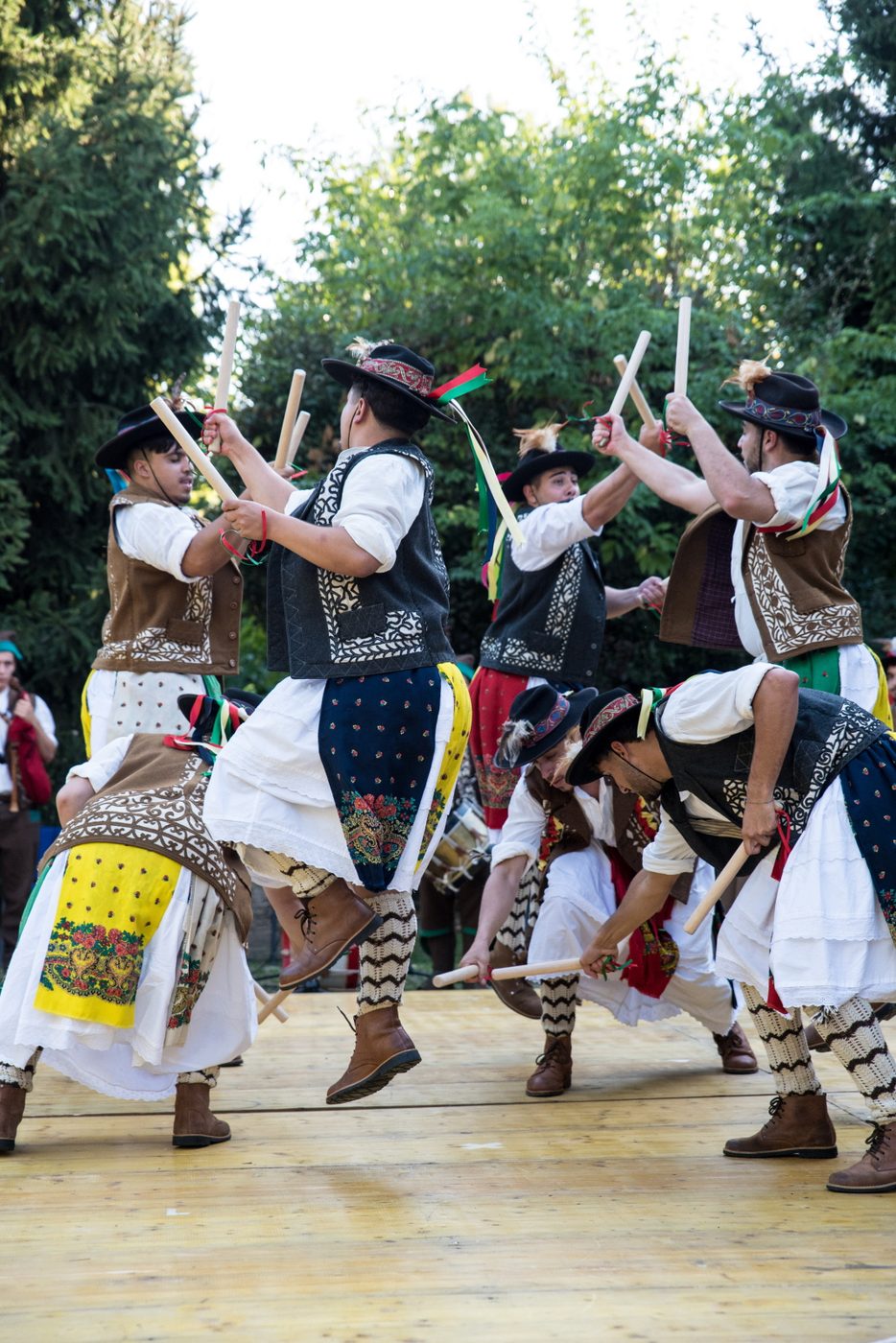
Each lhaço has its own character: warrior, farming, trades or feast. Tap “Show lyrics” to read the words in Mirandese.
The lhaço that closes every performance. The eight dancers form two towers and one of them makes four somersaults between them. In Sendim, on the last jump, the jumper holds a handstand between the towers while they turn 360°.
The four central dancers defend their tower while the four leaders attack it, striking sticks 25 times on each turn.
Each pair of dancers acts out an old rural trade: blacksmith, farrier, barber and wool carder.
Para aprender un oufício
Que me mantega senhor!
Ser barbeiro i ferreiro
Cardador ou ferrador!Cutting grass in summer and carrying it to the barns to feed the animals in winter.
Se quieres que te segue la yêrba
Trai la gadanha cula tue piêdra
Pa l’aguçar
Trai buis i carro
Pa la lhebar
Que segada stá,
Que segada stá.Dedicated to the good Christian who works the land, lives by the sweat of his brow and helps those in need.
L padre António era
Cristiano, honrado i prudente
Que mantenia su casa
Cun l suor de su frente
Ele tenie un huerto
un huerto tenie
Onde le cogia
El fruto del campo
Que el tiempo traíaSings of the monuments of the old Kingdom of León and the flavours of our land. Danced in almost the same way by every group.
Campanitas de Toledo
Las torres de San Simon
Reloijo de Benabente
La Catredral de Leon
Quando iban todas juntas
Parecia ua procisson
Lhebabam berças cun bino
Misturadas cun quinhon
Picaditas cun toucinho
Cun tchouriço inda melhor son
Cun chouriço melhor sonGoing to the “fado” means going to the party, to have fun and get together. This lhaço is dedicated to our Portuguese fado, a UNESCO World Heritage! Its music was also widely danced at feasts and pilgrimages, as the so-called “Repasseado Mirandês”.
The tale of a certain Canedo who raised a false fire alarm at a feast in Santo Antão da Barca — and got a good beating for it.
Canedo stá borracho
De bino i augardiente
Canedo stá borracho
De bino i augardiente
Mandou tocar a gaita
Delantre de toda giente
Mandou tocar a gaita
Delantre de toda giente
Yá matórun l Canedo
Más nun fui na sue tierra
Yá matórun l Canedo
Más nun fui na sue tierra
Fui an Santo Anton da Barca
Delantre de la capielha
Fui an Santo Anton da Barca
Delantre de la capielhaThe story of Mirandum, who went off to war and left everyone unsure whether he would return. From Easter to Trinity Sunday the wait drags on, until the sad truth sinks in: Mirandum is not coming back.
Mirandum se fue a la guerra
No sé quando bendrá
No sé quando bendrá, no sé quando bendrá
No sé bendrá por la pascua
Mirandum Mirandum Mirandela
No sé bendrá por la pascua
Se por la trinidade
Se pur la trinidade, se pur la trinidade
La trinidade se passa
Mirandum Mirandum Mirandela
La trinidade se passa
Mirandum nó biene yá…The story of a hare running up the hillside, chased by two greyhounds that cannot catch it. In the end, nobody knows who fired the shot: “was it you who shot at it, or was it me?”
Aquelha canhada arriba
Un lhiebre bi correr
Iban dous galgos trás d´eilha
I no la podiron cojer
Tu que l’atiraste
You que l’atirei
Nin tu la mataste
Nin you la matei
Nin you la matei
The bicha — “snake” in Mirandese — is danced without striking the sticks, to the sound of castanets, and closes every lhaço except the religious ones. It recalls ancient fertility and solstice dances and, in the warrior lhaços, celebrates victory. In Sendim the bicha footwork is unlike any other group’s.
Repertoire: Salto ao Castelo, 25 de roda, 25 aberto, Ofícios, Padre António, Mirandum, La Yerba, Cabalhero, Canedo, Senhor Mio, Fado, Campanitas de Toledo, Lhiebre, Tchina, Bitcha, Palombitas, Águilas and Alqueire.
Tap the dots to discover each piece of the costume.
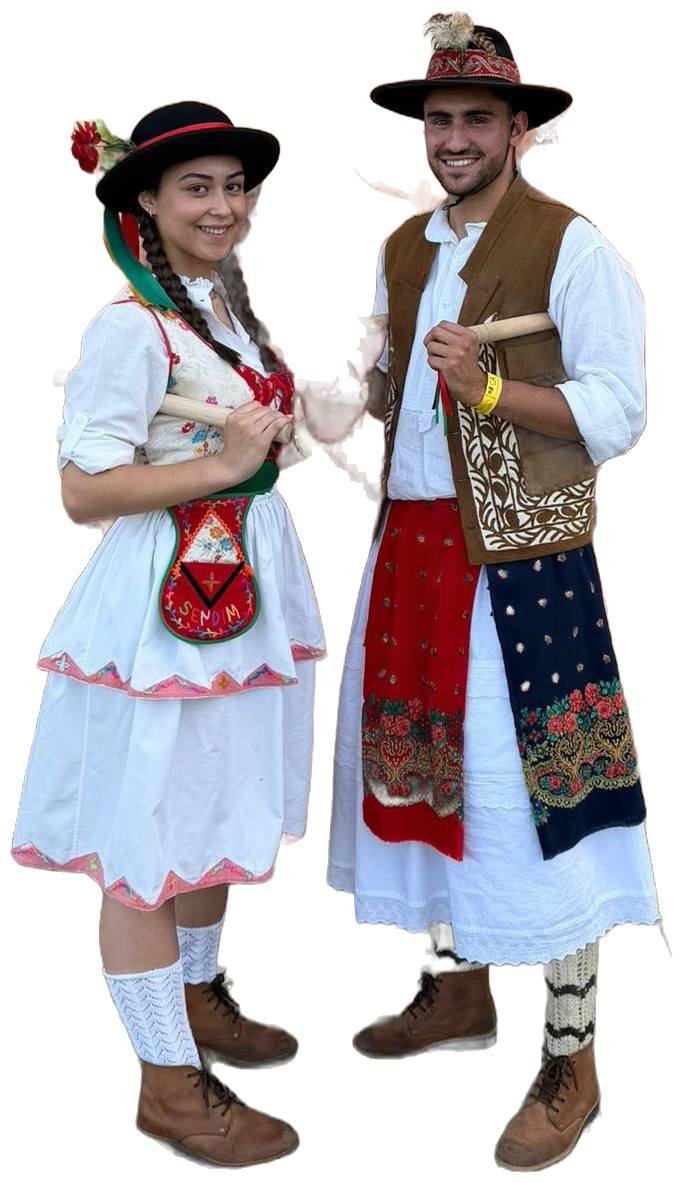 PauliteiraPauliteiro
Tap the dots: the red ones show the costume, the gold ones open each instrument.
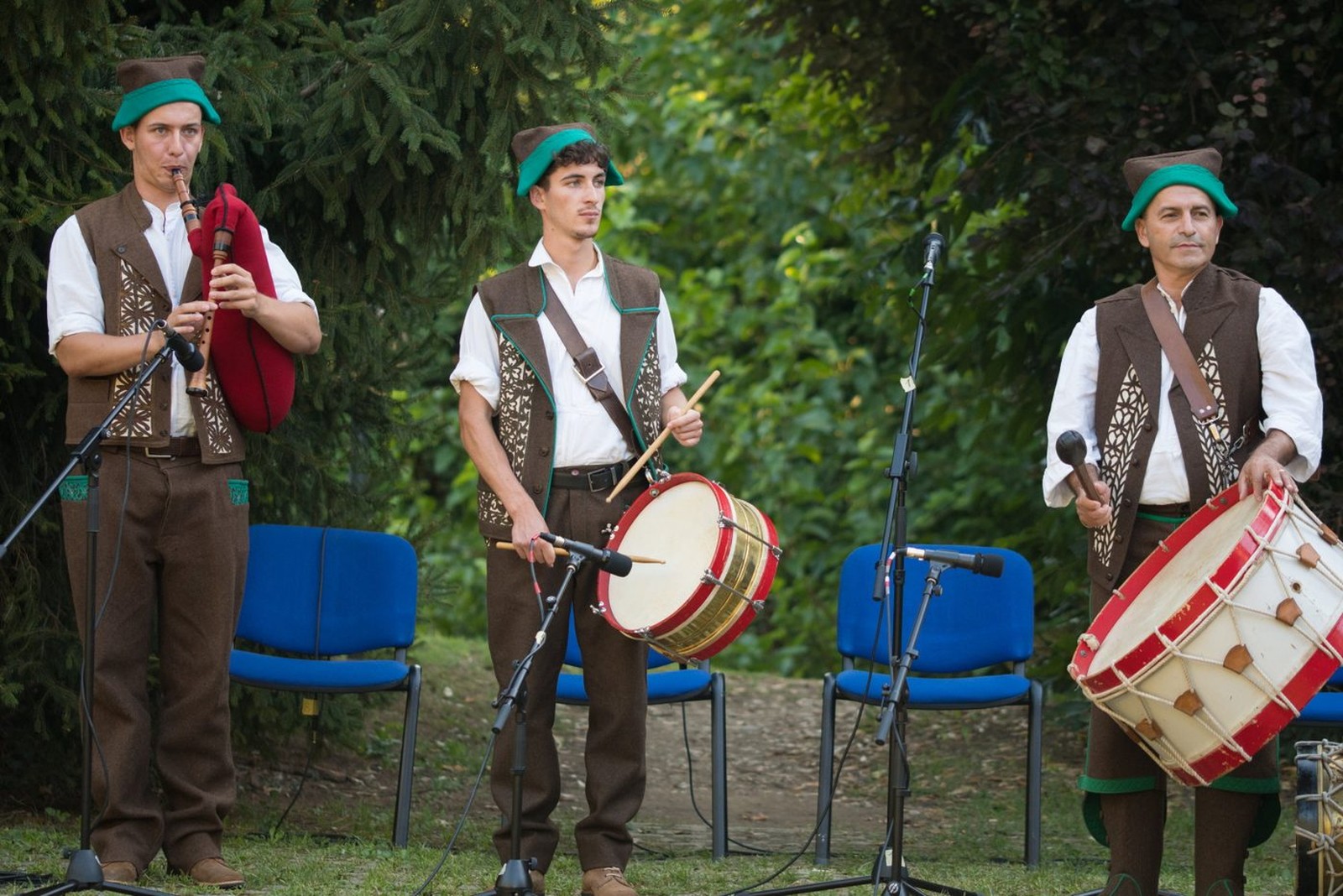
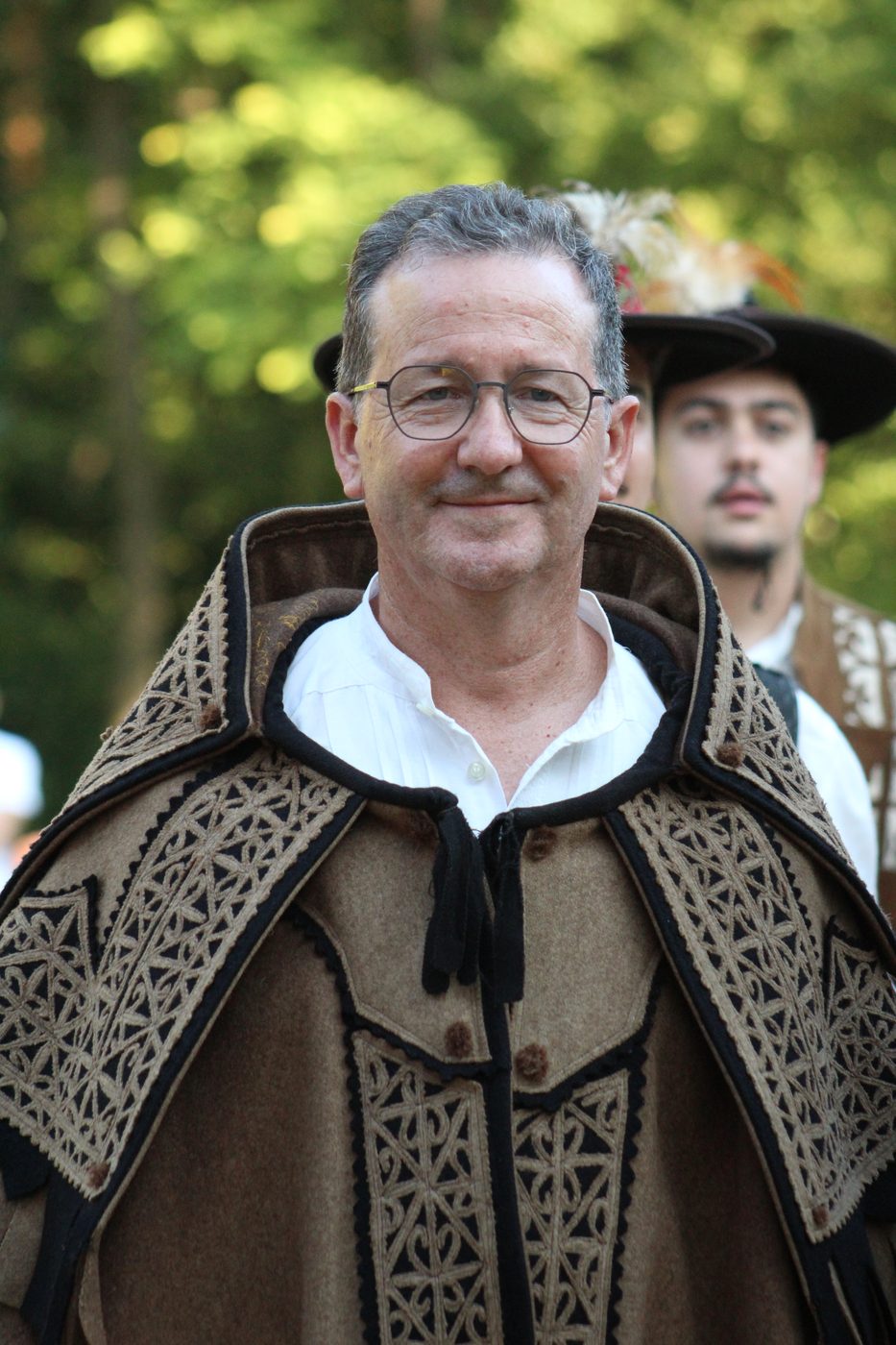
The group is always accompanied by the Man of the Capa d’Honras, worn by the eldest member or the president. Born as a shepherd’s cloak, the Capa d’Honras is the most emblematic piece of Mirandese dress; the craft of making it has been on the National Inventory of Intangible Cultural Heritage since 2022.
La lhéngua mirandesa ye munto mais qu'ua forma de falar: ye ua parte biba d'a nóssa eidantidade, un tesouro cultural que guarda la stória, las tradeciones i l’alma de la Tierra de Miranda.
An 29 de Janeiro de 1999, cun la Lei n.º 7/99, l mirandés fui ouficialmente reconhecido cumo lhéngua oufecial de Pertual, a par de l pertués, tornando-se la segunda lhéngua oufecial de l paíç.
Esta riqueza cultural ye tamien sentida ne ls Pauliteiros i Pauliteiras de Sendin. Na beilça, na música i ne ls trajes tradecionales, damos bida a ua hardança que passa de geraçon an geraçon. Tal cumo la lhéngua, la beilça de ls palos ye un simblo de pertença, d'ourgulho i de ligaçon a las nóssas raízes.
La lhéngua fala de quien somos. La beilça amuestra quien somos. Juntos, mantemos biba la tradiçon de la Tierra de Miranda.
Feasts, festivals and cultural events — in Portugal and abroad.

AI-generated answers based on this website. They may contain mistakes, so please check with us.